

In this article
Senior backend interview questions with AI practice should prepare you for more than algorithms. Senior backend loops usually mix coding, architecture, reliability, data modeling, incident response, and prioritization. Interviewers want to know whether you can build and evolve services that hold up in production, not only whether you can solve one isolated problem on a whiteboard.
That is why strong preparation often combines AI interview copilot for backend engineers, backend engineer interview prep, and broader system design interview work. InterviewCue is most useful when it helps you rehearse the specific questions senior backend interviewers use to test production judgment under pressure.
What are common senior backend interview questions
The most useful answer to what are common senior backend interview questions is to group them by the job of a senior backend engineer.
Expect questions in five buckets:
- Service design and API boundaries.
- Data modeling and consistency tradeoffs.
- Scaling, caching, and queueing decisions.
- Reliability, observability, and incident handling.
- Prioritization and cross-team communication.
Examples include:
- Design an idempotent payments or order-processing workflow.
- Explain how you would migrate a monolith endpoint into services.
- Discuss how you would choose between strong consistency and availability.
- Walk through how you would diagnose rising tail latency.
- Describe a time you changed an interface to reduce operational pain.
Those questions sit at the intersection of software architecture interview, software engineer interview prep, and operational judgment. They are also why senior backend candidates often benefit from DevOps interview prep and SRE interview AI coach style drills even when the title is not infrastructure-heavy.
Senior backend questions vs. coding-only prep
Senior backend interview questions with AI practice vs coding interview prep is not an either-or decision. It is about coverage.
Coding practice still matters because many backend loops include implementation rounds. But coding-only prep can leave gaps in areas like interface design, migration sequencing, observability, failure recovery, and system tradeoffs. Senior interviewers care about those gaps because they are the places where backend decisions affect the rest of the company.
That is why a live coding interview assistant should be only one part of the plan. After you solve the problem, you should also be able to explain how the service behaves under retries, partial failure, schema evolution, or delayed downstream dependencies. InterviewCue is useful because it lets you move from code-level rehearsal into AI mock interview style follow-ups without changing context.
Practice for distributed systems roles
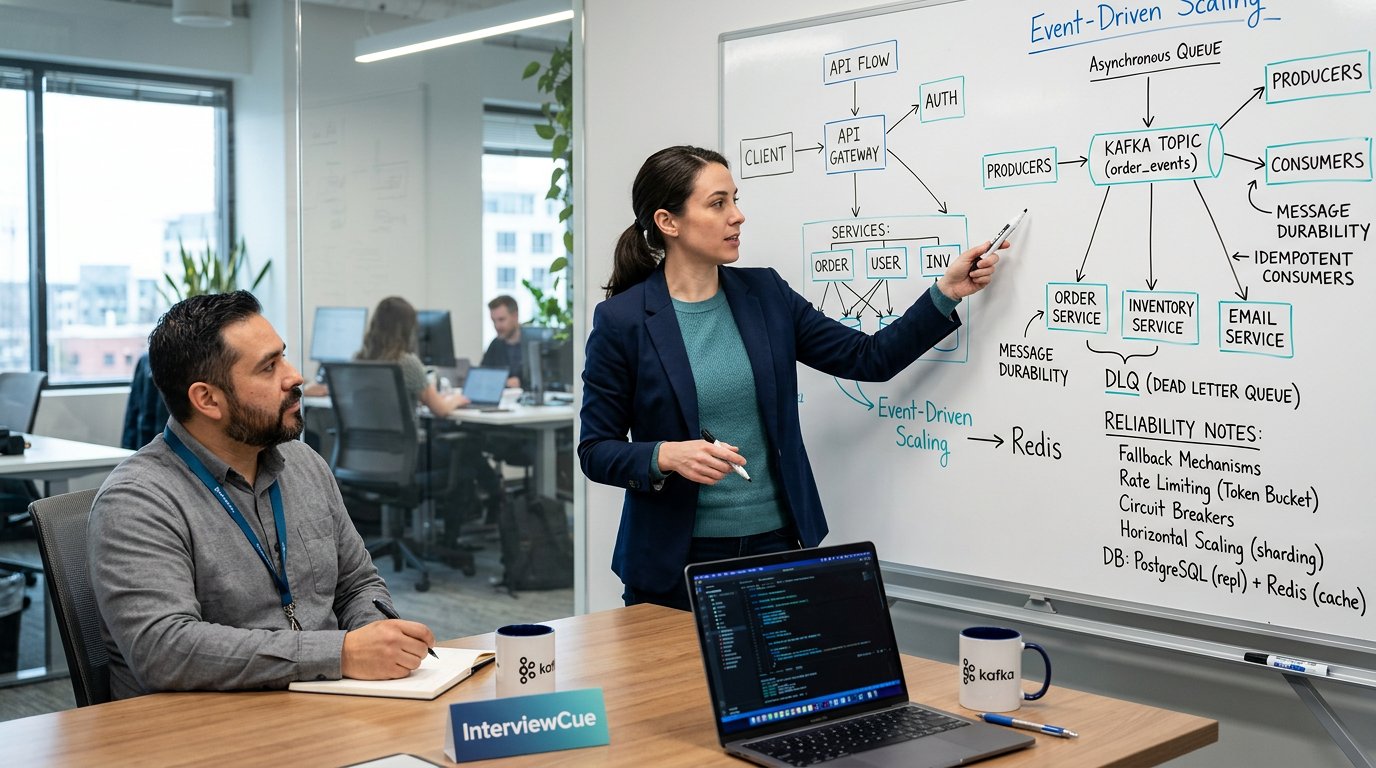
Senior backend interview questions with AI practice for distributed systems roles should focus on how systems behave when coordination gets hard.
For distributed systems-heavy roles, expect deeper questions on:
- Idempotency and deduplication.
- Partitioning and hotspot mitigation.
- Backpressure and queue management.
- Retries, timeouts, and circuit breaking.
- Schema evolution and compatibility.
- Consistency models and failure handling.
For example, if you are asked to design a job scheduler, a strong answer should cover not only the scheduling API but also lease ownership, duplicate execution protection, observability, and what happens during worker or database failure. That is the level where AI interview copilot for backend engineers style practice becomes valuable: it helps you keep the answer structured while still sounding like someone who has run real systems.
How to judge senior backend practice quality
The best senior backend interview questions practice tool should pressure-test reasoning, not just produce prompts.
Look for a tool that can:
- Ask follow-ups on failure modes and tradeoffs.
- Challenge vague answers about scaling.
- Distinguish API design from implementation details.
- Push for metrics, SLOs, or debugging signals.
- Adapt the question to platform, SaaS, marketplace, or data-product contexts.
InterviewCue is strongest when it makes backend candidates rehearse the transitions interviewers care about most: from requirements to interface, from interface to data model, from data model to operations, and from operations back to business impact.
Senior backend interview questions guide
This short senior backend interview questions guide works well before a final round:
- Prepare one coding problem, one service design prompt, and one incident story each day.
- For every design answer, add a forced section on failure modes and observability.
- Practice naming tradeoffs early instead of saving them for the end.
- Rehearse one answer with stricter latency, cost, or consistency constraints.
- Review whether the answer sounded senior because of judgment, not because of jargon.
The strongest senior backend interview questions with AI practice are the ones that simulate the real pressure of owning backend systems in production. InterviewCue helps create that pressure in a structured way, which is why senior backend interview questions with AI practice can improve both confidence and decision quality before the actual interview loop.