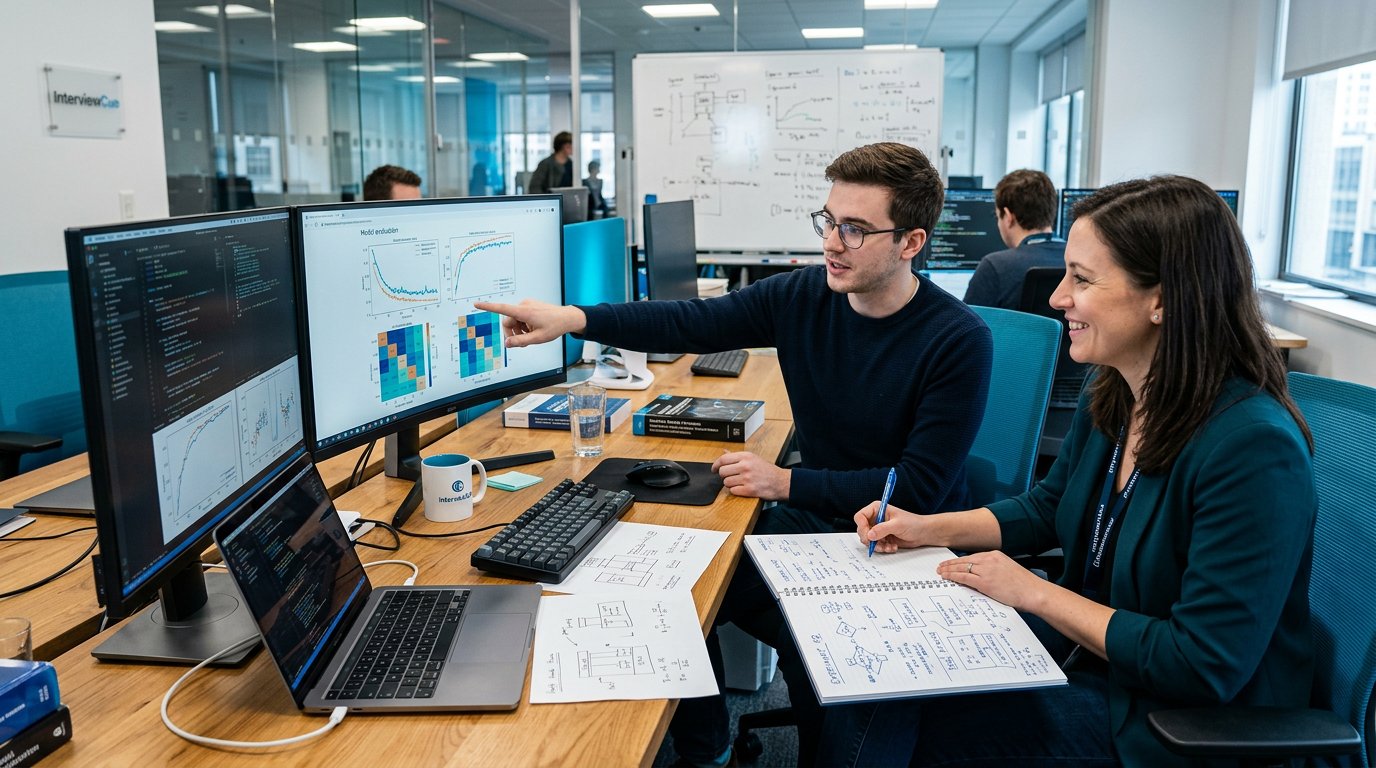
A research engineer AI mock interview should help you explain why an experiment matters, how you validated it, and where the model still fails. Research-engineer hiring loops are rarely about reciting papers from memory. They are about showing that you can turn ambiguous ideas into measurable systems, communicate tradeoffs, and defend your reasoning under follow-up pressure.
Good prep overlaps with AI engineer interview prep, AI fluency interview prep, and a disciplined system design interview guide, but research roles add their own layer: evaluation quality, data assumptions, iteration speed, and production realism. InterviewCue is most useful when it helps you practice that reasoning live instead of handing you polished but shallow answers.
What research engineer interviews test now
Most research engineer loops mix three different kinds of signal:
- Can you explain a modeling or experimentation decision clearly.
- Can you connect research choices to product or infrastructure constraints.
- Can you reason about failure cases, evaluation gaps, and next steps.
That is why technical interview practice for research roles should include more than coding drills. You still need algorithms, debugging, and some backend engineer interview prep habits, but the interviewer also wants to hear how you selected metrics, handled noisy data, and decided whether an improvement was real or just statistically convenient.
In many companies, the strongest answers sound half like a software architecture interview and half like an experiment review. You need to move from problem framing to data, model, evaluation, and deployment risk without losing the thread.
How to practice a research engineer interview with AI
The best answer to how to practice a research engineer interview with AI is to rehearse one concrete project at a time.
Pick a project where you changed data quality, model behavior, ranking, retrieval, latency, or evaluation strategy. Start by explaining the problem in one minute. Then force yourself to answer the follow-up questions that usually expose weak prep:
- Why did this metric matter?
- What baseline did you compare against?
- What failed before the final result worked?
- How would you know the result generalizes?
- What production constraint shaped the final choice?
An AI interview copilot is useful here because it can keep asking the uncomfortable questions that candidates often skip in solo prep. A live interview assistant style workflow is especially helpful when you practice talking through ablation studies, retrieval changes, or model-evaluation tradeoffs without drifting into vague language.
Research engineer AI mock interview vs ML mock interview
The difference in a research engineer AI mock interview vs ML mock interview is usually depth and ownership.
A generic ML mock interview often stays at the level of algorithms, textbook concepts, or high-level modeling decisions. Research engineer interviews go further. They ask how the work got evaluated, how quickly you iterated, what infrastructure or data bottleneck mattered most, and whether the idea still holds when real-world constraints appear.
That means your technical interview framework should include:
- Problem and success metric.
- Dataset or input quality assumptions.
- Baseline and comparison method.
- Experiment design and failure analysis.
- Shipping or integration constraints.
If your answer only covers architecture or only covers modeling, it sounds incomplete. InterviewCue is useful when it pushes you to connect the research workflow to engineering reality.
Research engineer AI mock interview for model evaluation and papers
Research engineer AI mock interview for model evaluation and papers should feel like a blend of journal club, design review, and production planning.
For paper discussion, practice answering four things clearly: what problem the paper solves, what changed relative to prior work, what assumptions make the result look stronger than it is, and what you would test before adopting it. Many candidates summarize the paper but never show judgment.
For evaluation questions, be ready to discuss:
- Offline versus online metrics.
- Error buckets and adversarial or edge-case behavior.
- Annotation quality and leakage risk.
- Latency, cost, and infra tradeoffs.
This is where AI mock interview practice helps. You can replay the same paper or evaluation prompt until the answer becomes concise. It also connects naturally to software architecture interview thinking when the interviewer asks how the model fits into a larger ranking, retrieval, or agent pipeline.
What to look for in the best AI mock interview for research engineers
The best AI mock interview for research engineers should do more than generate technical questions.
It should pressure-test your evidence. If you say a model improved, the tool should ask compared to what. If you say a paper is production-ready, it should ask about latency, evaluation drift, or dataset mismatch. If you say a retrieval pipeline scaled, it should ask which bottleneck moved.
InterviewCue is strongest when it helps candidates sound specific:
- Name the metric.
- Name the constraint.
- Name the tradeoff.
- Name the next experiment.
That kind of answer is what separates a confident research candidate from someone who only memorized concepts.
Research engineer AI mock interview guide
This short research engineer AI mock interview guide works well for a focused prep week:
- Pick two projects: one modeling-heavy and one systems-heavy.
- Practice a five-minute explanation for each with explicit metrics and baselines.
- Add one paper-review round and one model-evaluation round with interruptions.
- Rehearse one answer that connects the research choice to product impact or infrastructure limits.
- Finish with a mock close where you explain what you would test next and why.
The best research engineer AI mock interview does not make your background seem more impressive than it is. It makes your thinking easier to trust. InterviewCue is built for that kind of practice, which is why a research engineer AI mock interview can improve both confidence and technical credibility before the real loop starts.