

In this article
An ML system design interview AI coach should help you explain more than model choice. Machine learning system design interviews ask whether you can reason across data pipelines, feature freshness, offline evaluation, online serving, monitoring, fallback behavior, and the business tradeoffs behind the whole system. Candidates often know the components, but they lose the round because they cannot connect model quality to production realities.
That is why strong preparation usually combines AI engineer interview prep, a system design interview guide, and deeper software architecture interview habits. InterviewCue is most useful when it pressures you to explain the full pipeline the way a hiring panel for search, ranking, personalization, or content intelligence would expect.
What ML system design interviews test now
ML system design rounds are usually evaluating whether you can connect modeling choices to operating constraints.
Expect interviewers to probe:
- How training and serving data stay aligned.
- Which metrics matter offline vs online.
- Where latency budgets are spent.
- How you handle cold start, drift, or sparse feedback.
- What fallback behavior protects the user experience.
This is why a general technical interview framework matters. If your answer jumps straight to “use embeddings” or “fine-tune a model,” it can sound shallow. A better answer starts with the product goal, the user action you are optimizing for, and the constraints around freshness, experimentation, or cost.
Candidates moving from generic software loops into ML-heavy roles often notice the same gap that shows up in research engineer AI mock interview practice: you need to justify how you evaluate the system, not just how you build it.
How to prepare for ML system design interviews with AI
The best answer to how to prepare for ML system design interviews with AI is to rehearse the decisions between stages, not just the stages themselves.
For each prompt, practice this sequence:
- Define the product objective and success metric.
- Describe the data sources and freshness requirements.
- Explain the baseline system before the model gets complex.
- Add the training, feature, and serving path.
- Cover monitoring, iteration loops, and fallback behavior.
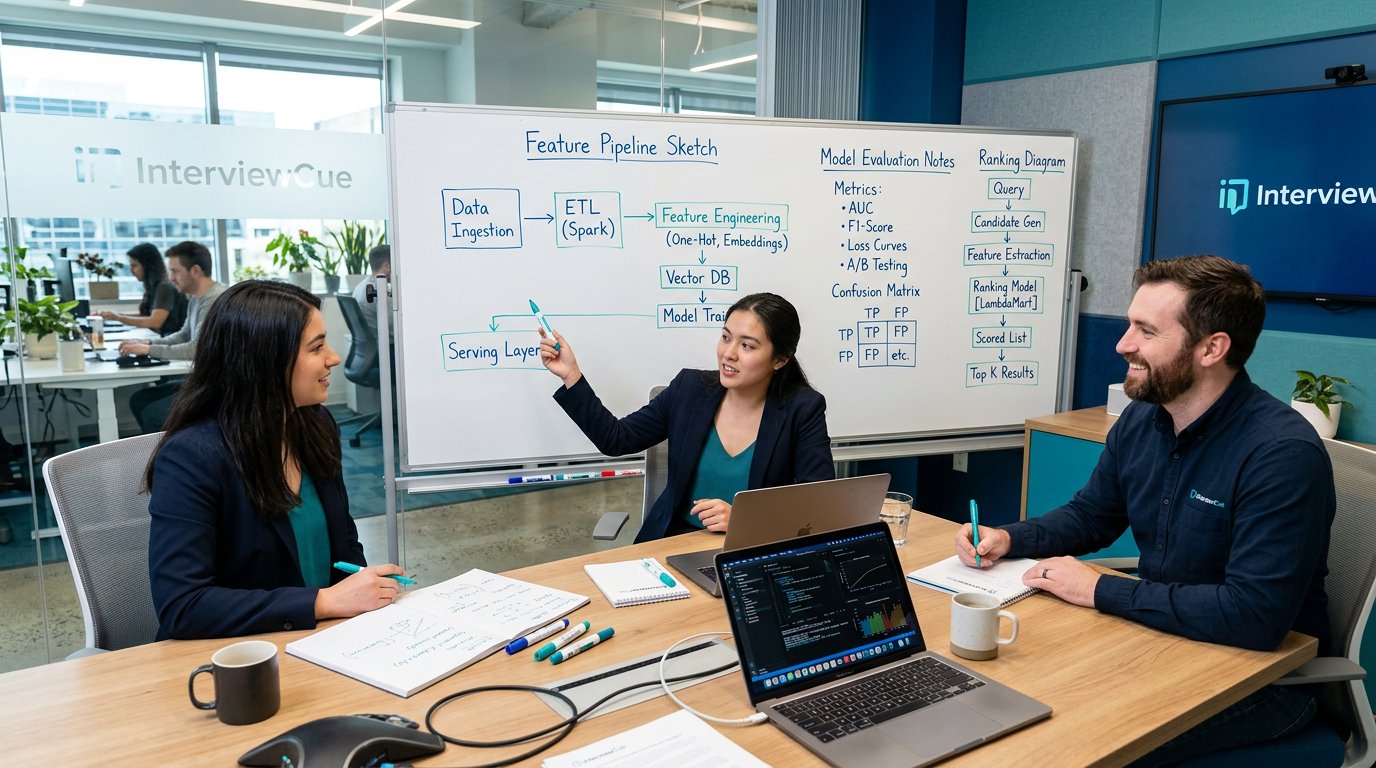
For a recommendation prompt, that might mean starting with candidate generation and ranking, then discussing feature logging, retrieval latency, offline metrics like NDCG, online metrics like CTR or retention, and what happens when features arrive late. For a fraud or moderation prompt, it might mean more emphasis on label quality, human review queues, and threshold tuning.
InterviewCue can act like a technical interview coach by forcing follow-ups that real panels use: “What breaks first?” “How do you debug bad outcomes?” “Would you favor a simpler model for latency?” That style of rehearsal also overlaps with AI fluency interview prep, because many teams now expect candidates to explain how they validate model behavior and tooling instead of treating AI output as inherently correct.
ML system design coaching vs. standard mock interviews
ML system design interview AI coach vs system design mock interview comes down to what you are trying to improve.
An assistant-style workflow is best when you want to iterate on one system repeatedly. It helps you tighten transitions between product requirements, data contracts, feature pipelines, and serving architecture. A mock interview format is better when you want full-round pressure with interruptions, timing limits, and unexpected follow-ups.
If your weak spot is structure, start with the assistant. If your weak spot is staying calm when the interviewer changes assumptions, switch to a system design mock interview AI coach flow after the structure is stable.
The strongest candidates use both. They refine one answer until it sounds clean, then test whether it still works when the interviewer asks for stricter latency, more aggressive personalization, or harder safety constraints.
Practice for recommendation and ranking roles
ML system design interview AI coach for recommendation and ranking roles should center on the production details that separate ML design from generic backend design.
A good answer should cover:
- Candidate generation vs ranking.
- Online feature freshness and store design.
- Training data logging and feedback loops.
- Bias or popularity feedback risks.
- Latency budgets for retrieval and ranking.
- Fallback logic when the model or features are unavailable.
For example, in a feed-ranking interview, it is not enough to say you would train a ranking model on click data. You should explain how you avoid leaking future signals, how you protect fresh content from never getting shown, and how you measure whether the ranking change actually improves user outcomes. That depth is what separates a broad backend engineer interview prep answer from one designed for ML systems.
How to evaluate coaching quality
The best ML system design interview AI coach should force operational clarity.
Look for a tool that can ask:
- What is the serving path and latency budget?
- How are labels collected and quality-checked?
- Which metric matters most at launch time?
- How do you detect drift or data skew?
- What simpler baseline would you compare against?
InterviewCue is useful when you want to turn scattered ML knowledge into one coherent narrative. It is not about sounding flashy. It is about proving that you understand how product goals, model evaluation, data systems, and user safety fit together.
ML system design practice plan
Use this short ML system design interview AI coach guide before ML-heavy interviews:
- Pick two prompts from ranking, recommendations, search, or moderation.
- Rehearse each from product goal to monitoring without skipping the baseline system.
- Add one round where the only focus is metrics, drift, and rollback decisions.
- Practice one follow-up where latency or freshness constraints suddenly tighten.
- Review whether your answer sounded like production reasoning or only model enthusiasm.
A strong ML system design interview AI coach makes you sound like an engineer who can ship and operate ML systems, not only talk about models. InterviewCue helps with that exact shift, which is why an ML system design interview AI coach can raise both confidence and answer quality before the real panel.